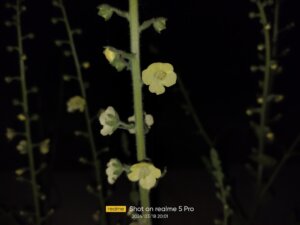
Scrophulariaceae
AngiospermsDicotyledonsGamopetalaebicarpellataePERSONALES
1 observation · 1 genus in Rajasthan
42 genera, 1,460 species
Widely distributed from temperate to tropical regions, especially diverse in
Africa.
Salient features:
Leaves alternate or opposite, stipules absent, flowers zygomorphic,
anther commonly opening by single slit, carpels 2, ovary superior, 2-chambered, ovules
many, fruit a capsule.
Major genera:
Verbascum (360 species),
Scrophularia (230), Selago (150), Sutera (140),
Budleja (100), Manulea (55) and Nuxia (30).
Description:
Herbs or small shrubs (Budleja),
often with Iridoids, hairs usually simple,
when glandular with short discoid head composed of many cells and with vertical partitions. Leaves alternate or opposite, rarely
whorled, simple, entire or dentate, venation
pinnate, reticulate, stipules absent. Inflorescence racemose: racemes or spikes.
Flowers bisexual, zygomorphic, or almost
actinomorphic, hypogynous. Calyx with 3-5
sepals, connate, persistent. Corolla with 4-
5 petals, united, usually bilabiate, or with
narrow tube broadening upwards, sometimes with nectar sac or spur, imbricate.
Androecium with usually 5 stamens, rarely
4 or 2, epipetalous, inserted in corolla tube,
filaments free, sometimes hairy (Verbascum),
anther bilocular, anther sac confluent and
opening by single slit right angles to filament, anther base not sagittate, pollen grains tricolporate. Gynoecium with 2
united carpels, ovary superior, bilocular,
ovules several to 1 (Selago) in each chamber, axile placentation, style 1, stigma
bilobed, ovary seated on a nectary. Fruit a
septicidal capsule, or schizocarp with two
nutlets (Selago); seed with curved or straight
embryo, endosperm present. Pollination by
insects. Seeds or nutlets dispersed by wind.
Economic importance:
The family has little economic importance. Verbascum is
sometimes grown as ornamental. Budleja
and Nuxia are commonly grown as
ornamentals.
Phylogeny:
The family is closely related to
Acanthaceae sharing the features of
zygomorphic flowers, pentamerous flowers,
stamens less than 5, bicarpellate superior
ovary and fruit a capsule. Scrophulariaceae
are distinct in presence of endosperm, anthers opening by single slit and the absence
of retinaculum. The genera including
Veronica, Linaria, Antirrhinum, Digitalis, etc.
formerly included under Scrophulariaceae have been variously separated under
Antirrhinaceae (Thorne, 1999, 2000) or
Plantaginaceae (Judd et al., 2002, APG II and
APweb, Thorne, 2006, 2007). The
Budlejaceae and Selaginaceae have been
merged with Scrophulariaceae in these systems. Monophyly of Scrophulariaceae is
clearly supported by morphology, rbcL and
ndhF sequences (Olmstead and Reeves,
1995). Verbascum and Scrophularia form a
clade characterised by hairy filaments, endosperm development and distinctive seeds
and are sister to rest of genera. Selago and
relatives (former Selaginaceae) form a clade
based on uniovulate locules and achene-like
fruits. Budleja is very much paraphyletic, but
several lines of evidence place it here
(Maldonado de Magnano, 1986b); Teedia and
Oftia have strong support as the sister group
to Budleja s. l. (Wallick et al. 2001, 2002).